
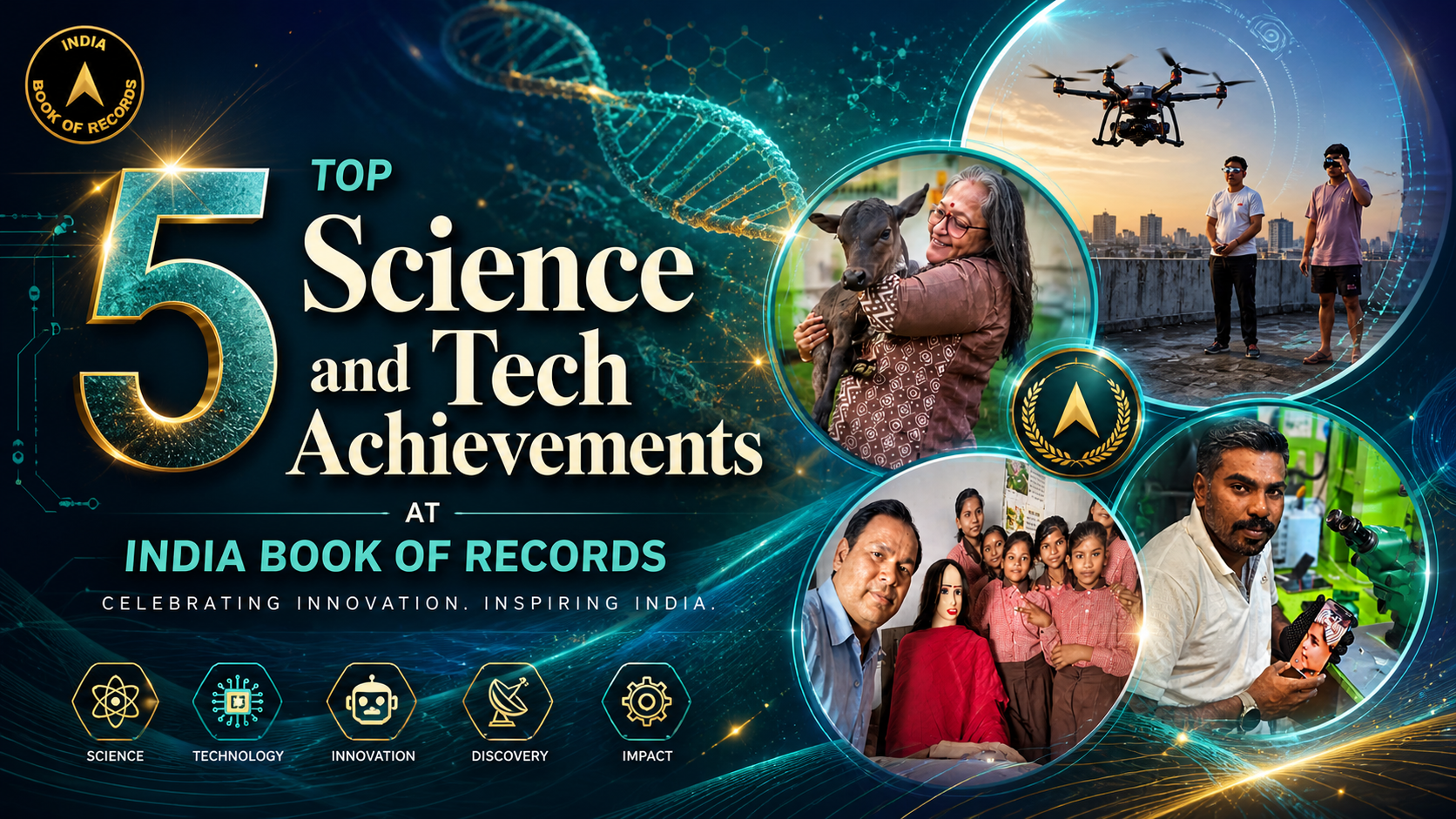
It is usually believed that creating new technology is not cost-effective. It is a common belief that it will incur a huge cost of creating something new, especially if you want to make a human-like robot. But Mohan Lal of Jhansi, Uttar Pradesh, successfully negated this notion. He set an extraordinary record of creating an AI robot using the minimum amount of investment.

He undertook a low-cost AI robot project for students ‘Suman’ with a servo motor, wiring and frame, using a minimum investment amount of just INR 2900. ‘Suman’, the AI robot, is capable of speaking in Hindi and teaching the rural students of her area.
He proved that monetary constraints can never stop a scientist from innovating. Moreover, he had no prior formal training in robotics or AI. His purpose in creating ‘Suman’ was to make education fun, inclusive, and interactive for rural children.
Cross-breeding is an age-old process which has been employed by our ancestors both for agricultural purposes and for animal domestication. Many different kinds of vegetables and fruits, such as carrots, bananas, etc., have been developed through cross-breeding, and so have many different breeds of domestic animals. Adopting this ancient technique, the young researchers of Dhunn Charitable Trust of Anand, Gujarat, were able to produce the smallest indigenous calf by adopting the process of cross-breeding.
This achievement was a major breakthrough for the scientists at the charitable trust, because the parent breeds used for cross-breeding were pure indigenous A2 breeds, whereas the offspring created by this process is a carrier of superior, easy-to-digest A2 milk proteins. The smallest indigenous calf was named ‘Harini’ (meaning deer). It is a tiny calf measuring merely 20 inches in height, 22 inches of heart girth, and it weighed just 12.360 kg.
Fixing things also involves the art of understanding the technology involved in the broken item. The more acquainted a person is with the tech of the broken gadget, the faster it can be fixed. And Abdul Shakkoor A.M. has mastered the art of fixing the touchscreen glass of a mobile phone.
Abdul, who hails from Thrissur, Kerala, has set the record for being the fastest to repair the touchscreen glass of a mobile phone. He repaired (without replacement) the touch screen glass (green display) of a mobile phone, iPhone 14 Pro, in 2 minutes and 12 seconds. The record was confirmed on August 2, 2025.
When Artificial Intelligence entered the Indian markets, many people got scared of it, thinking that it would eat up their jobs and leave them useless. But Saahas Ludhra of Faridabad, Haryana, became curious about the latest technology and used it to set a record for himself. He became the youngest to develop an empathetic AI-based mental health support system.
At a young age of 16 years, 2 months and 11 days, he became the Youngest AI developer in India 2026, by developing an empathetic AI voice and text-based mental health support system. He named it ‘SpeakUp Yuva AI’, and rightly so. This AI support system was built by him to help the younger generation cope with stress, anxiety, fear of judgment, cyberbullying, health and hygiene challenges. It was one of the most thoughtful scientific records in our record book.
Man is a curious animal. Its curiosity has led him to build some of the most eccentric gadgets of modern times. FPV (First Person View) drones are one such innovation. Rudraksh of Kanpur, Uttar Pradesh, let his fascination for FPV drones help him set an exceptional record.
He became the first teen to develop the maximum range of an FPV drone. His FPV drone measured 290 mm in length x 245 mm in width x 105 mm in height. His drone achieved a range of 7.266 km with a top speed of 105 kmph. He was only 17 years, 6 months and 2 days old when he achieved this fabulous feat.
Every record certified by the India Book of Records does something that goes beyond the individual. It creates a permission structure for millions of others. It creates a belief that we are way more than what we believe ourselves to be. And the innovative records recounted above are testament to how the talents of curiosity can help us achieve record-worthy feats.
India, as a nation, has time and again proved our excellence and mettle in the field of science. This nation has birthed great physicists and scientists like Homi Bhabha, Dr APJ Abdul Kalam, C.V. Raman and many others. At India Book of Records, we recognise this scientific spark of Indians in the form of various records we have documented in our Yearly books and Monthly Magazines. If your curiosity makes you put your mind into action and create things, then you too can get your name written amongst the prestigious names of Indian innovators in our record books.