
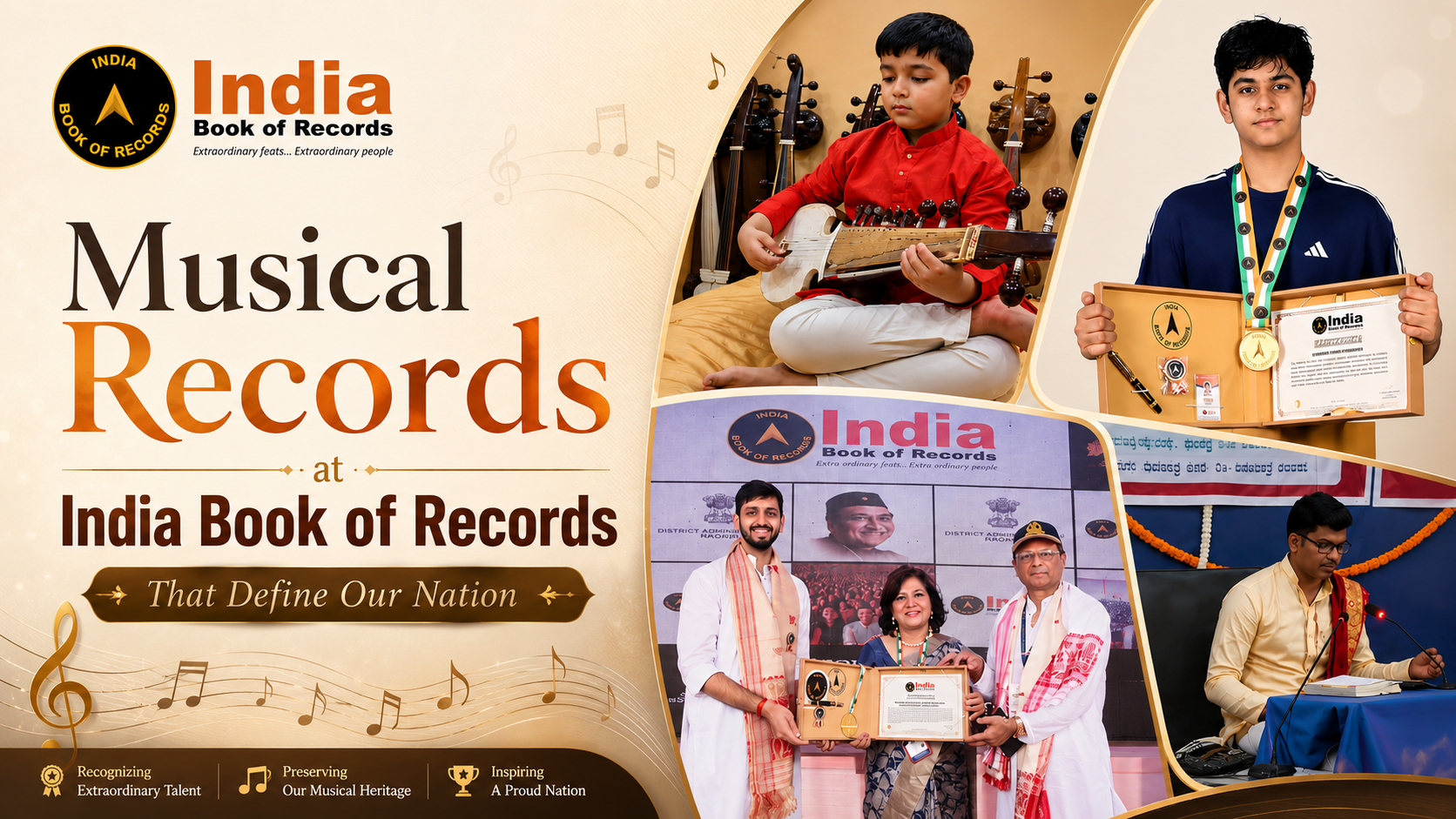
There is a country where a century-old man still plays the drum for a living, where a twelve-year-old produces and releases a full album on Spotify, and where seventeen thousand voices rise together to honour a beloved maestro. That country is India, and nowhere is its musical identity more vividly documented than in the pages of the India Book of Records (IBR).
From classical ragas to cutting-edge music production, from the folk percussion of Manipur to the ancient Kannada art of gamaka singing, IBR has quietly become the guardian of India’s most extraordinary musical moments. Here is a celebration of five such records. Each one is a story not just of individual achievement, but of a civilisation that has always found its truest expression in sound.
A Century Of Rhythm: Sapam Kullabi Singh And The Nata Pung
On the first of May, 2025, at the Sangeet Natak Academy Festival held in the prestigious setting of Vigyan Bhavan, Mysuru, something remarkable happened. Sapam Kullabi Singh, born on March 31, 1925, in Imphal West, Manipur, gave a Nata Pung performance lasting 30 minutes at a live event at the age of 100 years, 1 month, and 1 day. He became IBR’s oldest Nata Pung artist to perform live.

The Nata Pung is a sacred drum at the heart of Manipuri classical music and the Sankirtana tradition, classified by UNESCO as an Intangible Cultural Heritage of Humanity. The Meitei Pung (another name for the classical drum) has been central to the daily life in the Manipuri Gaudiya Vaishnava traditions from birth to death. It has played a big role in introducing Manipur’s culture to India and abroad since stage performances began in 1939.
That’s why Sapam Kullabi Singh, who was still a teenager at the time when this tradition was first staged publicly, deserves our whole attention for this long tenure as a Nata Pung performer, and he is not stopping even at his 100th year.
The voice of an Epic: Gamaka Singing and Kumaravyasa Bharata
Gamaka, also known as Kaavya Vaachana, is a centuries-old Karanataka art of storytelling through song. And Mr Prasad Bharadwaj of Shivamogga Taluk, Karnataka, chose this ancient art to set a record with the India Book of Records. He achieved a mesmerising record of the longest continuous ‘gamaka’ singing-based performance on ‘Kumaravyasa Bharata’.
His continuous performance commenced on January 24, 2026, at 5:30 PM and concluded on January 25, 2026, at 5:06 PM. His record-setting gamaka singing lasted a total of 23 hours and 36 minutes. He recited and sang verses from Kumaravyasa Bharata (also known as the Karnataka Mahabharata) in various Carnatic ragas, strictly adhering to the traditional Gamaka style. His record will definitely make sure that this precious and endangered classical art is witnessed, respected, and preserved.
Thousands of Voices Honouring Dr Bhupen Hazarika
Bhupen Hazarika is a national musical gem birthed by the land of Assam. That’s why in Assam, his birth anniversary is celebrated with much fervour and enthusiasm. On his 99th birth centenary, the Nagaon District Administration, Assam, gathered thousands of people to celebrate the occasion and set a musical record at the same time.
They set the record for the maximum number of people singing and clapping together to commemorate Dr Bhupen Hazarika. A total of 16,781 participants united to sing his iconic anthem “Manuhe Manuhor Babe” promoting his timeless message of peace and humanity on September 10, 2026.
The choice of song was also very intentional, for this song was the most enduring expression of philosophy that Dr Hazarika’s entire life’s work represented. The objective of this gathering was to celebrate Dr Hazarika’s enduring musical legacy and a nation’s letter of gratitude to one of its greatest singers.
The Young Sarod Prodigy
The sarod is among the most technically unforgiving instruments in the Hindustani classical tradition. It demands absolute precision. We, at the India Book of Records, had the privilege to witness a difficult record being set by tiny but well-practised hands.
Jashojeet Mukherjee (born on April 10, 2017) of Howrah, West Bengal, set the record for playing the maximum number of ragas on different sarod instruments. You must be wondering what the different sarod instruments mean. Here, different sarod instruments mean 11 different kinds of sarods which were made in 1840, 1860, 1900, 1956, 1978, 1987, 1991, 2010, 2015, 2022 and 2024.
He played 11 different Indian classical ragas, including Bilawal, Bhimpalasi, Durga, Kirwani and other ragas, on these 11 sarods in 9 minutes and 7 seconds, at the age of 9 years and 3 days. IBR’s documentation of this record is an acknowledgement of not just this little prodigy’s command over his art but also th the support system which helps set such a beautiful record in the world of music.
India’s Youngest Music Producer
If the first four records speak to India’s deep classical inheritance, the fifth reminds us that India is also a country of startling musical futures. Vihaan Kumar of Gurugram, Haryana (born January 11, 2013) set the IBR record for the youngest music producer by releasing a nine-track album titled ‘Haan Is Cool’ on Spotify under the stage name ‘Haanburger’ at just 12 years, 9 months and 18 days.
Not a single, not a demo, but a complete, independently produced body of work, commercially released and confirmed on April 6, 2026. In an era where production tools are increasingly accessible, what cannot be taught is the instinct to build a coherent album with its own identity.
Vihaan had that instinct. IBR’s recognition is a signal to every young musician in India that the studio is not a room you earn with age. It is a room you earn with vision.
India’s Music, Recorded for Posterity
What unites these five records is not just ambition. It is love: a fierce, patient, sometimes lifelong love of music in all its forms. Be it a centenarian Meitei Pung vadak, a gamak performer, a stadium full of singing people, a child prodigy playing sarods, or a twelve-year-old music producer. All these records are testimonies of how music brings people together.
In a country with such an overwhelming density of musical talent, heritage, and innovation, India Book of Records ensures that the extraordinary is never simply absorbed into the noise but documented, celebrated, and handed forward to those who come next. Because in India, music is not just art. It is memory. And every record is a way of making that memory permanent.
How To Set A Musical Record?
If you or your institution has achieved a medical milestone that deserves national recognition, you simply have to follow the following steps:
Find your musical talent: Discover what kind of musical talent you have that would help you set a record.
Gather Evidence: Provide video evidence, photographs, and witness testimonials to support your claim.
Make It Official: Submit the Record Application Form and take your place among India Book of Records’ most remarkable medical records.
So let hesitation be a thing of the past, and rock the world with your tunes. Apply today at India Book of Records!