
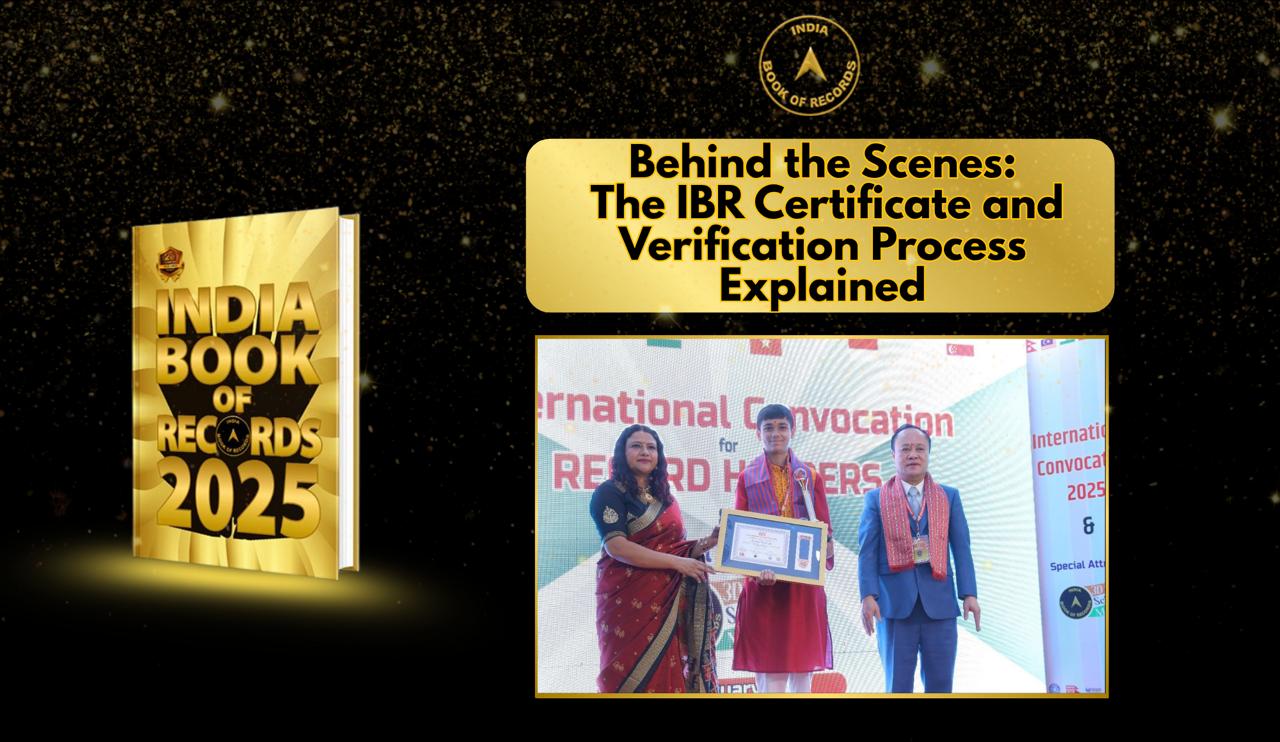
To have an entry in the India Book of Records (IBR) is something that becomes a badge of honor for individuals and groups who want to be history-makers. When the moment of glory arrives, it is thrilling, but the journey towards it is as great. Right from documentation of attempts to awarding certificates, the journey is challenging, transparent, and richly rewarding.
Here in this blog, we take a behind-the-scenes look at how record claims are authenticated, what credentials render a claim authentic, and through which process the highly desired IBR Certificate is released.
About India Book of Records
India Book of Records is a large repository of the records created and accomplished by people from all sections of society in India. Whether it is some unprecedented physical accomplishment, some ground-breaking invention, or an act of endurance, IBR identifies unique achievements and validates them officially.
The authentication process is strict in a bid to ensure authenticity. Every aspirant of the records has to pass through very careful inspection before being given his spot in the prestigious book. The process from the record attempt to the certification process is of several steps, each fulfilling its vital role in ensuring IBR’s credibility.
How to Apply for a Record in IBR
To be eligible for an IBR record, one has to submit an online application available on the IBR website on the link:
https://indiabookofrecords.in/record-application-form/
One has to provide basic personal details and explain in brief about the record claim. The procedure conventionally involves these steps:
- Complete Name
- Mobile No.
- Date of Birth
- Gender
- Occupation
- Permanent Address
- Detailed description of your attempt (3000 characters limit)
Then the applicant has to upload the evidence if he/she has already attempted the record. One has to provide the following evidence to proceed further:
- Videos of the attempt, preferably with a stopwatch.
- Proof of birth (birth certificate) or (10th class mark sheet)
- Proof of address (Aadhar card)/(Passport) etc.
- One best picture of the applicant while attempting.
- Newspaper cuttings or Television coverage links related to the record attempt (if available).
- Contact details of the witnesses of the record attempt.
- Any other documents supporting the claim.
The application is then analyzed by IBR officials to establish if it qualifies for a record or not. The applicant is promptly contacted via email and telephonically about further details or evidence required to process the record claim.
IBR Recognition Process
When an applicant has attempted a record, it needs to be verified as authentic. This is the most important step in the process. This is the methodology of how record verification is done:
1. Evidence Collection
Applicants have to submit evidence of their record. This will usually comprise:
- High-quality images and video evidence of the attempt
- Witness statements from trustworthy individuals
- Coverage by the media, if any
- Official reports and data records
All the submissions are to be unambiguous and verifiable, and there should be no misinterpretation.
2. Independent Verification by IBR Officials
India Book of Records specialists scrutinize the submitted materials. Their functions are to:
- Verify the authenticity of the record attempt
- Compare the achievement against current records
- Verify IBR standards compliance
If there is any discrepancy, the applicant is requested to furnish additional clarification or documentation.
3. On-Site Verification (If Necessary)
For certain mass or complex record attempts, IBR adjudicators conduct on-spot visits to carry out live verification. This is particularly required for records involving mass participation, adventure sports, or technological innovation.
Their presence ensures complete transparency, minimizing errors or impersonation.
4. Record Attempt at IBR Office
Applicants also have the option to attempt a record at the IBR office. In such cases the attempt is shown live in social media and is verified and processed promptly then and there at the time of attempt only and the certificate kit is also provided to the applicant on the spot.
5. Virtual Verification of Record
In some cases, record verification is done virtually through a video call. In such cases the applicant may attempt the record at his/her own place only while displaying the whole attempt and evidence to IBR officials on the videocall itself. This option is useful in the cases of large collection of things.
Issuance of IBR Certificates
After the verification process is over and the record has been formally accepted by the editors, the record is entered in the IBR database. The applicant is intimated via email about the confirmation of record or achievement and informed about the procedure to obtain the certificate. As soon as the applicant completes the formalities, he/she is issued an IBR Certificate. The certificate is an official acknowledgment of their accomplishment and serves as an evidence of his addition to the elite records archive of IBR.
Along with the certificate, the recordholder gets several other useful items in the beautiful kit. The kit comprises a personal Identity card of the recordholder, a beautiful pen, a shining medal, IBR badge, IBR annual book and 2 parking stickers.
1. Certificate Information
The India Book of Records Certificate includes:
- The title and description of the record
- Name, date of birth and place of the record-holder
- The IBR official seal and signature, and bears a unique hologram
- Date of record verification
It is a formal confirmation of the achievement and may be utilized for professional attainment, media features, and personal achievement.
2. Publication in the India Book of Records
The record will be printed in the monthly magazine and annual issue of the India Book of Records on certification. Awarded achievements will also be displayed on the IBR website, social media, and television, providing record-holders national and international publicity.
Importance of Record Integrity
India Book of Records gives a lot of emphasis to record integrity. In order to avoid misinterpretations and remain credible, the company adheres to very strict norms:
- No tampered evidence: Disqualification is given if there is any falsification of submission.
- Strict validation: Double-checks and triple-checks are given to every record.
- Transparency: Rules and procedures are made open to applicants.
This helps IBR in becoming a credible forum for rewarding real accomplishments.
Challenges in Verification of Records
Even if a process is systematic, records verification does not come without problems:
- Misinterpretation of Guidelines: Some applicants misread or fail to follow the precise guidelines, and their applications are delayed or rejected.
- Insufficient Evidence: Inadequate documentation causes delays and rejections.
- Scale Problems: Records of mass participation pose additional attention and effort for verification.
In spite of all this, IBR continues to perfect its techniques to suit various forms of records while maintaining fairness.
Success Stories
Several record holders have utilized their IBR certification as a springboard to their success. Entrepreneurs, athletes, educators, and artists alike generally gain broader publicity and career prospects after becoming certified.
For instance, Jyash Tholiya of Pune, Maharashtra, who made a record for being the youngest to sing the National Anthems of all the countries, was invited to display his talent at prestigious events in India and Vietnam, and has already become a star performer at a young age.
